"For myself, I always write about Dublin, because if I can get to the heart of Dublin I can get to the heart of all the cities of the world. In the particular is contained the universal."James Joyce (1882-1941)
Showing posts with label literary Dublin. Show all posts

Friday, August 29, 2014

Sheridan Le Fanu - leading ghost-story writer of his day

Yet another Irish and Dublin-born author has been honoured with a Google Doodle. Sheridan Le Fanu (1814 - 1873) joins the ranks that include James Joyce, Flann O'Brien and most significantly, Bram Stoker. The occasion of this Google tribute is to mark the 200th anniversary of his birth.


Described as the leading ghost-story writer of the nineteenth century (Source: Wikipedia), he is widely credited with pioneering the genre of vampire fiction, directly influencing compatriot and fellow Dubliner, Bram Stoker in the composition of his classic work, Dracula. While not quite as well known as Stoker's oeuvre, Le Fanu's novella, Carmilla, preceded Dracula by more than 25 years. With its dark erotic overtones, it has been adapted many times and in different media since it was first published in 1871. In an age when vampire lore and legend has assumed a worldwide following, spawning a global industry of books, films, cultural iconography and so forth, it may surprise some to learn that the origins lie very much here, in Ireland.

Carmilla.jpg
"Carmilla" by David Henry Friston - English wikipedia via http://www.lacrypte.net/images/carmilla1.jpg.
Licensed under Public domain via Wikimedia Commons.

Joseph Thomas Sheridan Le Fanu was born in Dublin on 28 August, 1814. His place of birth is given as 45 Lower Dominick Street on Dublin's northside but his family moved soon thereafter, to the parish of Chapelizod in the vicinity of Phoenix Park. There is today, both a road and a park named after him in the Ballyfermot area of Dublin, close to where he grew up.

Born into a middle class family of literary distinction (Both his grandmother Alicia Sheridan LeFanu and his great-uncle Richard Brinsley Sheridan were playwrights (his niece Rhoda Broughton would become a successful novelist, according to Wikipedia) he struggled nevertheless, for most of his life with financial difficulties, leading to a varied but interesting career. Such circumstances probably lead to his support for popular causes of the day that carried a strong emphasis on social and political reform. He moved in circles that included Isaac Butt, Samuel Ferguson, John Mitchel, Thomas Francis Meagher.

Among his best known works, still widely read today, include Uncle Silas (1864) and In a Glass Darkly, a collection of short stories published shortly before his death that includes his seminal work, Carmilla.

Thursday, November 8, 2012

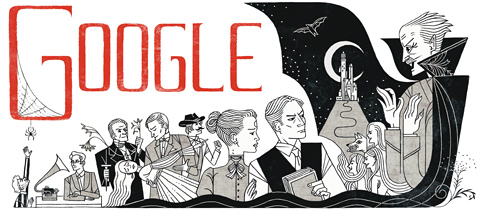
Bram Stoker honoured with Google Doodle

For the second time in recent weeks an Irish writer has been honoured with a Google Doodle. The centenary of the death of Bram Stoker was observed earlier this year in April. Google however has chosen to commemorate his birth, with a doodle depicting Stoker's immortal creation (literally) of Count Dracula.


Stoker was born in Dublin. His early years were spent at 15 Marino Crescent, Clontarf, where he was bedridden until the age of 8 due to a mysterious illness. It was during this period of convalescence that the seeds of his future literary output were sown. His mother, who grew up in the west of Ireland and had witnessed first hand the horrors of the Great Famine in Ireland of the 1840s, recounted stories to him from that period. These obviously left a lasting impression, even when he regained his health.

Bram Stoker is arguably Ireland's most successful writer, although his reputation has been rather overlooked in his home country; a country that is generally proud if its literary accomplishments and heritage. This year however, on the centenary of his death, a Bram Stoker Festival has been inaugurated. The festival "aspires to honour his memory and achievements and to encourage a spirit of enquiry and curiosity about the creator of one of literatures most famous characters."

His fame rests chiefly on the novel Dracula, which has grown to become more than a literary masterpiece; it has in fact become a cultural icon and achieved a certain level of immortality (pardon the pun) among fans of the vampire horror genre.  According to the Bram Stoker Festival website:
Though when he died, not a single obituary mentioned his most famous work, today it has been translated into over fifty languages and Count Dracula has become the most filmed fictional character in movie history.

In fact, Stoker's literary output was prolific. Other works, such as The Lady of the Shroud or The Lair of the White Worm are still in print and have also been adapted for other media including TV an cinema.

Bram Stoker was born on this day, 8th November, in 1847.

Friday, October 5, 2012

Flann O'Brien Honoured with a Google Doodle

Flann O'Brien's 101st Birthday

Irish novelist, playwright, journalist, satirist, Brian O'Nolan (aka Flann, O'Brien, aka Myles na gCopaleen) has been honoured with a Google Doodle. He is the second Irish author to be served with such an accolade: James Joyce was the subject of the Doodle that commemorated Bloomsday 2004.

Although born in Strabane in Co Tyrone the author O'Nolan was a well known character in Dublin during his lifetime. He attended University College Dublin. His parental home was in Blackrock and he lived for most of his life at various addresses in South Dublin.

The various pseudonyms he employed throughout his literary career were due to restrictions placed upon him in his role as a civil servant. His father's early death meant that he was obliged to support a large family of brothers and sisters. He himself died childless. The position of civil servant was both prestigious and well-paid in Ireland of the time, which was largely poor and agrarian. Regulations and internal culture of the Irish civil service meant that senior officers were prohibited from publicly expressing views on political, controversial or sensitive matters. O'Nolan "was, indeed, forced to retire from the civil service in 1953." [Source: Wikipedia]

Today his works are widely read and celebrated, captivating succeeding generations. He is particularly remembered for his novels that include At Swim-Two-Birds, The Third Policeman, An Béal Bocht. He was the subject of an international conference in Vienna in 2011 from which an International Flann O'Brien Society has been established.

Closer to home, the inaugural Flann OBrien Literary Festival will take place over the weekend of Friday 12th and Saturday 13th October in O'Nolan's native Strabane and neighbouring town of Lifford. Full details including programme of events are available here.

Search Amazon for Flann O'Brien

Wednesday, September 12, 2012

Two Poems - MacDonagh and MacNeice

We were contacted recently by Niall MacDonagh, son of Donagh MacDonagh, who had this to say about Dublin Made Me, the title of the poem which also serves as the name of this website:
I just need to record that it upsets me that, of all the poetry, plays, stories my father left behind, THAT piece of verse is what is remembered. The thing is that it is not about Dublin at all but a put down of the rest of the country. Read it and you will see what I am saying.

Now, if you want a very fine poem about Dublin (by a non Dubliner) see this:

Dublin

Grey brick upon brick,
Declamatory bronze
On sombre pedestals -
O'Connell, Grattan, Moore -
And the brewery tugs and the swans
On the balustraded stream
And the bare bones of a fanlight
Over a hungry door
And the air soft on the cheek
And porter running from the taps
With a head of yellow cream
And Nelson on his pillar
Watching his world collapse.
This never was my town,
I was not born or bred
Nor schooled here and she will not
Have me alive or dead
But yet she holds my mind
With her seedy elegance,
With her gentle veils of rain
And all her ghosts that walk
And all that hide behind
Her Georgian facades -
The catcalls and the pain,
The glamour of her squalor,
The bravado of her talk.
The lights jig in the river
With a concertina movement
And the sun comes up in the morning
Like barley-sugar on the water
And the mist on the Wicklow hills
Is close, as close
As the peasantry were to the landlord,
As the Irish to the Anglo-Irish,
As the killer is close one moment
To the man he kills,
Or as the moment itself
Is close to the next moment.
She is not an Irish town
And she is not English,
Historic with guns and vermin
And the cold renown
Of a fragment of Church latin,
Of an oratorical phrase.
But oh the days are soft,
Soft enough to forget
The lesson better learnt,
The bullet on the wet
Streets, the crooked deal,
The steel behind the laugh,
The Four Courts burnt.
Fort of the Dane,
Garrison of the Saxon,
Augustan capital
Of a Gaelic nation,
Appropriating all
The alien brought,
You give me time for thought
And by a juggler's trick
You poise the toppling hour -
O greyness run to flower,
Grey stone, grey water,
And brick upon grey brick.
– Louis MacNeice

A good point and well-taken. Grateful we are too, to be reminded of Louis MacNeice's sombre yet elegant paean to the city. Irish people of a certain generation will possibly recall being taught both MacNeice's and MacDonagh's poems as part of English curriculum.

Donagh MacDonaghDonagh MacDonagh (1912-1968) was an Irish writer, judge, presenter, broadcaster, and playwright. According to Wikipedia:
He wrote poetic dramas and ballad operas. He published three volumes of poetry: Veterans and Other Poems (1943), The Hungry Grass (1947) and A Warning to Conquerors (1969). He also edited the Oxford Book of Irish Verse (1958) with Lennox Robinson. A play, Happy As Larry, was translated into a number of languages. He had three other plays produced: God's Gentry (a ballad opera about the tinkers), Lady Spinder (about Deirdre of the Sorrows and the Three sons of Ussna and by far his best writing) and Step in the Hollow a piece of situation comedy nonsense. He also wrote short stories. He published Twenty Poems with Niall Sheridan; staged first Irish production of Murder in the Cathedral with Liam Redmond, later his brother-in-law. Furthermost he was a popular broadcaster on Radio Éireann.

His books are no longer in print but we understand that a project is underway to publish all of his writings, in e-book form, or at least those that can be found: it appears that he was a very prolific writer. Websites that contains links to his poems and plays can be found here and here. The National Library of Ireland also holds some of his personal letters and papers, in addition to those of his father, Thomas MacDonagh, also a poet and playwright, who was among the leaders of the 1916 Rising subsequently executed for his role, his name appearing as one of the signatories to the Proclamation of the Irish Republic.

Louis MacNeice was born in Belfast in 1907, to parents originally from the west of Ireland. It is recorded that when he was six, his mother was admitted to a Dublin nursing home suffering from severe depression and he did not see her again. Inauspicious beginnings you might say, to his relationship with a city that would inspire him to write those lines.

His first trip to Dublin appears to have been in 1934, when he met with William Butler Yeats. The poem, Dublin was written in 1939 and first appeared in a collection entitled The Last Ditch, which was published in 1940. The strength and endurance of the lines which he penned, are nowhere better exemplified than in this recital, given by a true Dubliner, albeit recorded on the streets of Galway, a city to be found amongst -
The raw and hungry hills of the West
The lean road flung over profitless bog
Where only a snipe could nest
Where the sea takes its tithe of every boat.
Bawneen and currach have no allegiance of mine


One can only wonder how words like "This never was my town ...and she will not have me alive or dead" must resonate in the heart of a homeless exile.


Reference Material:

Saturday, June 16, 2012

Bloomsday 2012 (and what a wet, miserable day it is)

Today is Bloomsday, a day when Dublin's literary set take time to celebrate and reflect upon the life and work of Dublin-born writer, James Joyce. It is observed annually on June 16th every year, because it is the fictional events of that day which are chronicled in Joyce's novel Ulysses.

This year, like every other year since the first annual Bloomsday celebration in 1954, the streets of Dublin, despite the appalling weather which we have been having, will bear witness to a general carnival atmosphere. Some will attempt to re-trace the steps of Joyce's protagonists. Others will most like take refuge in a pub somewhere. Anyone who doesn't catch pneumonia will probably come back to do it all over again next year.

Happy Bloomsday Everyone!

Try not to get wet.

Bloomsday performers outside Davy Byrne's pub, Dublin, Bloomsday 2003
Public Domain via Wikimedia Commons

Popular Posts

Labels

1930s (1) 1940s (1) 1950s (1) 1960s (1) 1970s (2) 19th century (1) Arthur Fields (1) Bagatelle (1) Bloomsday (1) Bram Stoker (4) Bram Stoker centenary (2) Carmilla (1) City Full of Ghosts (Dublin) (1) Clontarf (2) Colin Farrell (1) Customs House (1) Damien Dempsey (1) David Kelly (1) Dennis McIntyre (1) Donagh MacDonagh (2) Dracula (3) Dublin (6) Dublin in the 1980s (1) Dublin Lockout (1) Dublin Made Me (2) Dublin Town (1) Dublin: One City One Book (1) Easter Rising 1916 (2) famous Dublin writers (2) Flann O'Brien (1) from the archives (2) Google Doodles (2) historic Dublin (2) history (6) history of Dublin (1) Howth (1) Hugh Leonard (1) In Tua Nua (1) Ireland's capital city (1) Irish history (1) Irish Independence struggle (1) Irish literature (1) Irish mathematicians (1) Irish personalities (1) Irish scientists (1) James Connolly (1) James Joyce (1) James Larkin (1) James Plunkett (1) literary Dublin (5) local history (1) Louis MacNeice (1) Mike Scott (1) Music (4) nostalgia (2) old photographs of Dublin (2) Padraig Pearse (1) Pete St John (1) Peter O'Toole (1) Photography (1) Poetry (3) Proclamation of the Irish Republic (1) Ronnie Drew (2) Roots (TV series) (1) Sheridan Le Fanu (2) sightseeing (1) St. Michan's Church (1) Steve Wickham (1) Strumpet City (1) Summer in Dublin (1) The Dubliners (2) The Ferryman (1) The Great Famine (1) The Rare Ould Times (1) The Waterboys (1) tourist attractions (2) tourist guide (1) TV documentaries about Dublin (1) Ulysses (1) Unesco (1) vampire fiction (1) vampirism (2) videos (1) visiting Dublin (1) W.B. Yeats (1) William Martin Murphy (1) William Rowan Hamilton (1) World War I (1)