"For myself, I always write about Dublin, because if I can get to the heart of Dublin I can get to the heart of all the cities of the world. In the particular is contained the universal."James Joyce (1882-1941)

Saturday, January 28, 2023

Dublin's North Bay Area Explored in New Book

A History and Guide to the Dublin North Bay Area with Dennis McIntyre

– From the Stately Customs House to the Wild and Charming Howth Head –

Customs House to Howth Head: A History and Guide to the Dublin North Bay Area is author, Dennis McIntyre's latest contribution to Irish, local, social and cultural history.

The trek, from the stately Customs House in the city centre to the wild and charming Howth Head, is documented in all its facets, angles and aspects. Exhaustively researched, the book is both informative and entertaining, in addition to being copiously illustrated with a well-chosen selection of images.

This is not just a local history but rather, a series of local histories, covering Dublin's Customs House and Docklands areas, North Strand, Summerhill, Ballybough, Fairview, Marino, Donnycarney, Clontarf, Killester, Raheny, Kilbarrack, Bayside, Donaghmede, Baldoyle, Sutton and Howth. It has everything that local history should have – and that bit extra.

Dennis McIntyre is the previously published author of Meadow of the Bull: A History of Clontarf (1987) and has also written about other aspects of Irish history, such as in Bram Stoker and the Irishness of Dracula (2013) and Irish Nationalism, Irish Republicanism and the 1916 Easter Rising (2016).

Customs House to Howth Head: A History and Guide to the Dublin North Bay Area is published by Shara Press and is available to buy online (RRP €19.99).

The book will formally launched at Clontarf Castle Hotel on Wednesday, 1 February starting 8pm, where copies will also be on sale and the author will be on hand to sign them. Joe Harrington of Sunshine Radio will provide the keynote address, while Ciaran Murphy, of Near FM radio, will perform the introductions.

Dennis McIntyre is an author, historian, tour guide, broadcaster and former teacher. Originally from Sligo, he has lived on the northside of Dublin for a number of years and he has established a reputation as a local historian. In addition to his writing, Dennis McIntyre also serves as founder and director of Dublin North Bay Tourism and the Stoker Dracula Gothic Organisation. Previously published works are also available to buy online.

Listen to the podcast of Dennis McIntyre talking about his new book with John Connor on NearFM’s Lifeline Programme.

Sunday, April 24, 2016

1916 and all that - the Literary Legacy of the Easter Rising

On this day in 1916, precisely 100 years ago, an armed insurrection broke out on the streets of Dublin, heralding the start of what was originally dubbed the Sinn Féin Rebellion but would come to be known as the Easter Rising. It was an event of enormous significance - primarily political but not without cultural and literary implications also. Its reverberations were felt worldwide.

A week of heavy fighting ensued. The rising was eventually quashed by the superior military power of British armed forces, although strategic failures on the part of the rebels and, indeed, bad luck also played a part in ensuring the outcome. Nevertheless, while often dismissed as a military failure (or even a 'heroic failure'), the fact remains that, aside from the General Post Office, which served as the Rising's headquarters, no other rebel position fell until the order to surrender was received. Thus, while the order for unconditional surrender was issued on Saturday, 29 April (by Padraig Pearse, co-signed by James Connolly) fighting continued until the following day, as it took time for the surrender order to filter through to certain rebel strongholds.

Birth of the Irish Republic
Walter Paget [Public domain], via Wikimedia Commons

The immediate public reaction to the Rising was one of bewilderment, confusion, even outright hostility. Yet, as events proceeded, the mood changed, almost as the leaders of the Rising had predicted it would. The words of a contemporary observer, William Butler Yeats, are often cited to convey the sense of ambiguity but also foreboding that followed in the immediate aftermath:
All changed, changed utterly:
A terrible beauty is born.

- from Easter 1916 by W.B. Yeats, September 25, 1916

Whatever Yeats' may have had in mind about the 'change' and the 'terrible beauty' it had given birth to, in hindsight and at this juncture, we have the opportunity to see, in a more fully fledged form, just what the leaders of the Rising were driving towards. As Yeat's alludes, it was not so much the Rising itself but the aftermath and the series of event that was set in motion, initiating and making inevitable broad, sweeping, wholesale changes in the conduct of affairs between people and nations of the earth.

The Easter Rising was, arguably a catalyst for all of this. It marked the opening salvo that ushered in a new era, as the age of empire began its long, slow retreat, to be replaced by a new age of democracy based national sovereignty, backed up by universal suffrage and government based on popular rule. An age of international co-operation based on the free association of free people and nations.
All of this is presaged by the Rising's manifesto, as proclaimed on the steps of the GPO on this day in 1916. It is those words that ring clear today, just as they resonated with people at the time. The Proclamation of the Irish Republic is a literary masterpiece in its own right, not just of its time but for all time.

Easter Proclamation of 1916
By originally uploaded to the English Wikipedia by w:User:Jtdirl
[Public domain], via Wikimedia Commons


Wednesday, November 11, 2015

WWI Armistice Day: Recalling the Exploits of the Fighting Irish

The First World War formally ended on this day in 1918. The armistice that ended hostilities came into effect 'on the eleventh hour of the eleventh day of the eleventh month'.

All told, 16 million (counting combatants and civilians) are believed to have perished in what has gone done in history as one of the deadliest human conflicts and, at the time, no doubt the deadliest. The map of Europe was completely redrawn and the world was altered completely by the outcome of the war.

Ireland has its own experience and legacy arising out of the conflict into which it was drawn, even though it was not an independent country at the time. Indeed, the emergence of an independent Irish state was in no small part an outcome of the war: the Easter Rising of 1916 can seen as one small but important chapter of that war.

Conflicting emotions surrounding participation in World War I, as felt by many Irish people both then and now, are touched upon here in a poem by Joe Canning entitled, Once in a Dublin Bar Room, which we are reproducing here with the kind permission of the author.

For some, the fighting goes on!

Once in a Dublin Bar Room
by J.Canning

On a stool in a bar room in Tallaght,
Sat a young man returned from the war.
Lost in his thoughts, he sat silent
As the bartender polished the jars.
The silence was suddenly broken
By Dunleavy sat down by the door,
"Would ye look at yer man in the corner.
Just back from Gallipoli's shore.
That blackguard up there on the bar stool,"
He said, "Yes boy! I'm talking of you.
You dare to come back to this city,
Do you take us for eejits and fools.
When you were away on your travels,
Fighting for England at war,
Real men were fighting in Ireland,
Men fit to drink in a bar.
Have you not got a tongue in your head, Sir?"
Dunleavy continued to scowl.
"Have you no shame returning to Tallaght?
Have you nothing to say to us now?"
The stranger continued his sipping,
Looked at the bar man and sighed,
"Can you please tell that clown to be quiet,
Or I'll up and I'll blacken his eyes."
Dunleavy incensed by the statement,
Stood up and cast coat to the floor
Rolled his shirt sleeves to his elbows
And instantly crossed the pub floor.
"Is it fighting yer after, ye traitor?"
He clenched his hard fists with a grin,
"Be careful, Sir!" uttered the stranger.
"Contain yourself, reel yourself in.
I've heard you're a true Irish patriot,"
The stranger did say with a grin,
"Those medals you earned in the fracas;
You fought against cruel black and tan.
Be careful of what you are saying,
And it's true that I fought in the war,
Take care that you don't touch my person,
Or I'll scatter you all round the bar."
"Would you look at the face of the traitor!"
Dunleavy points out to the bar,
"Would ye look at the wounds earned at Suvla,
Would ye look at the Ottoman scars."
The bar man said, "Hush now, Dunleavy!
Leave this young man at his peace,"
But Dunleavy, the bully, continued to sully
As he spouted more scorn and disgrace.
The stranger then stared at Dunleavy,
"They tell me, round here you're the man,
But they don't know when you served in London,
You threw down your rifle and scrammed.
They don't know the 10th from the Curragh,
Have you marked as a rat and a coward.
Those brave men all fine sons of Ireland,
That the Turks with machine guns devoured."
Dunleavy now shamed and defeated,
Exposed as a shirker from war,
Spoke not a word and clearly disturbed
Did shamefully exit the bar.
The stranger then turned to the others,
"I care not what you think of me,
For I fell for the lie,'If you join in the fight,
You'll come home to an Ireland's that's free'.
He continued as all stood and listened,
"It's cost me my wife and my son.
It's cost me my friends and my neighbours,
Wherever I go I am shunned."
Dunleavy then entered the bar room once more,
To the stranger his fists he did draw,
'Till he stepped from the stool, called Dunleavy a fool,
And he clinically shattered his jaw.

Copyright (c) J. Canning 2015. All rights reserved. Published here by kind permission of the author - www.facebook.com/thebirdstownboy


Monday, March 30, 2015

Time Passes Slowly

Take just five minutes out of your day to appreciate this short video taken around the streets of Dublin, which includes some of the city's most recognisable landmarks, captured in stunning time lapse detail.


This video was filmed over a period of four months and expertly edited by film student, Ammar Saleh, who says that it is his first time lapse. Our thanks to him for sharing it with us.

Friday, August 29, 2014

Sheridan Le Fanu - leading ghost-story writer of his day

Yet another Irish and Dublin-born author has been honoured with a Google Doodle. Sheridan Le Fanu (1814 - 1873) joins the ranks that include James Joyce, Flann O'Brien and most significantly, Bram Stoker. The occasion of this Google tribute is to mark the 200th anniversary of his birth.


Described as the leading ghost-story writer of the nineteenth century (Source: Wikipedia), he is widely credited with pioneering the genre of vampire fiction, directly influencing compatriot and fellow Dubliner, Bram Stoker in the composition of his classic work, Dracula. While not quite as well known as Stoker's oeuvre, Le Fanu's novella, Carmilla, preceded Dracula by more than 25 years. With its dark erotic overtones, it has been adapted many times and in different media since it was first published in 1871. In an age when vampire lore and legend has assumed a worldwide following, spawning a global industry of books, films, cultural iconography and so forth, it may surprise some to learn that the origins lie very much here, in Ireland.

Carmilla.jpg
"Carmilla" by David Henry Friston - English wikipedia via http://www.lacrypte.net/images/carmilla1.jpg.
Licensed under Public domain via Wikimedia Commons.

Joseph Thomas Sheridan Le Fanu was born in Dublin on 28 August, 1814. His place of birth is given as 45 Lower Dominick Street on Dublin's northside but his family moved soon thereafter, to the parish of Chapelizod in the vicinity of Phoenix Park. There is today, both a road and a park named after him in the Ballyfermot area of Dublin, close to where he grew up.

Born into a middle class family of literary distinction (Both his grandmother Alicia Sheridan LeFanu and his great-uncle Richard Brinsley Sheridan were playwrights (his niece Rhoda Broughton would become a successful novelist, according to Wikipedia) he struggled nevertheless, for most of his life with financial difficulties, leading to a varied but interesting career. Such circumstances probably lead to his support for popular causes of the day that carried a strong emphasis on social and political reform. He moved in circles that included Isaac Butt, Samuel Ferguson, John Mitchel, Thomas Francis Meagher.

Among his best known works, still widely read today, include Uncle Silas (1864) and In a Glass Darkly, a collection of short stories published shortly before his death that includes his seminal work, Carmilla.

Wednesday, October 16, 2013

William Rowan Hamilton, Irish Mathematician and Discoverer of Quaternions

This rather poorly maintained plaque under Broome Bridge, which straddles the Grand Canal on the northside of Dublin, marks the spot where a certain Irish mathematician had a Eureka moment, on this day (16th October) in 1843. It is a rather humble acknowledgement of a discovery that would prove to be of groundbreaking importance.

Broom bridge plaque
By Wisher at en.wikipedia [Public domain], from Wikimedia Commons

The inscription reads:
Here as he walked by on the 16th of October 1843, Sir William Rowan Hamilton, in a flash of genius, discovered the fundamental formula for quaternion multiplication i² = j² = k² = ijk = −1 & cut it on a stone of this bridge.

William Rowan Hamilton portrait oval combined
William Rowan Hamilton
Public domain, via Wikimedia Commons
William Rowan Hamilton was a midnight child; his date of birth is given as 3-4 August 1805. Growing up, he showed a remarkable aptitude for languages but as he approached his adult years, he started to concentrate more on mathematics - the universal language.

Having studied at Trinity College, Dublin he was appointed Professor of Astronomy in 1827, prior to his graduation and took up residence at Dunsink Observatory, where he lived and worked for the rest of his life.

It was on the occasion of one such stroll from the observatory at Dunsink, along the Grand Canal in the company of his wife that Hamilton had his moment of inspiration that continues to be commemorated, to this day. Mathematicians from all over the world have been known to take part in the commemorative walk retracing Hamilton's steps, which takes place every year on the anniversary.

The event is justly celebrated. The fundamental formula for quaternions continues to have relevance to mathematics in both the theoretical and applied fields, including computer graphics, control theory, signal processing, and orbital mechanics.

Broom Bridge (or Brougham Bridge as Hamilton called it)
Public domain via Wikimedia Commons


Monday, August 26, 2013

Man on Bridge - a photographic archive

'Man on Bridge' is the title of a fascinating project that documents the life and work of street photographer, Arthur Fields, just as he documented the various comings and goings on one of Dublin's best known landmarks, over a 50-year period.

Beginning sometime in the 1930s, until his retirement in 1985 at the age of 84, Arthur took photos of passers-by on Dublin's O'Connell street. Working seven days a week, with hardly ever a break, it is estimated that he took over 182,500 photographs in his lifetime.

Now a web-based project wants to bring all these photos together. People are being asked to submit their own photos taken by Arthur, together with their personal memories and reminisces related to the photograph. Just some of the photos collected so far are available on this Flickr photostream. Included among them are some well-known and instantly recognisable faces.

More about this project is available from El Zorrero Films who have provided this video.


Thursday, April 25, 2013

James Plunkett's Strumpet City - Book of the Month for April

Dublin: One City, One Book is an initiative that encourages Dubliners, and everyone interested in the culture of the city, to read one book (the same book) during the month of April each year. James Plunkett's classic, Strumpet City has been selected as the book for 2013, the year that marks the 100th anniversary of the Dublin Lockout.

The Dublin Lockout was an event that saw over 20,000 workers in Dublin locked out from their places of employment, in a bid by employers of the city (lead by William Martin Murphy) to stamp out trade unionism and organised labour. Strumpet City is a historical novel set against the backdrop of these events.

Regarded by some as 'the great Irish novel', the story was also turned into a successful mini-series, with a script by the late Hugh Leonard and Peter O'Toole playing the role of James Larkin, the leader of the ITGWU who lead the resistance to the employers.

The series was immensely popular in Ireland and was even picked up by broadcasters overseas. It is often fondly remembered for the performance by actor David Kelly (who died last year) in the role of Rashers Tierney. Actor Bryan Murray, who also had a central role in the series, recalls that at the time it was seen almost as an Irish Roots - the TV series about African-American slavery which appeared around the same time.


Wednesday, January 30, 2013

A Drive around Dublin through the Decades

1930s and 40s

No information about this footage except that it dates, apparently, from the 1930s and 40s.


Late 1950s

The footage is grainy but about as much as could be expected for the technology that existed at the time - no cellphones, digital cameras, CCTV, and so on.


1965

This footage was obtained, apparently, from a CIE training video. You will notice that Grafton Street is not yet pedestrianised (that didn't happen until the 1980s) while Nelson's Pillar still has a commanding presence over O'Connell Street (it would be gone by the following year).


1976

We've had this one before but it's worth including here for comparison purposes.


Wednesday, December 5, 2012

A Dubliners' Dublin

The late Ronnie Drew of The Dubliners takes us on a stroll through Dublin in this documentary that has recently turned up on YouTube. Going by Ronnie's comment in the opening segment about The Dubliners 'singing the praises' of the city for 25 years, that would mean that the footage contained here would date from around 1987. 


Thursday, November 8, 2012

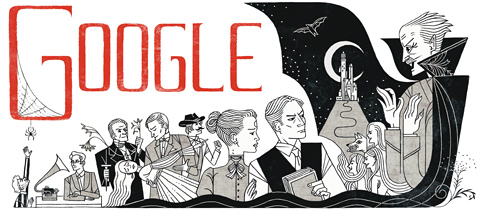
Bram Stoker honoured with Google Doodle

For the second time in recent weeks an Irish writer has been honoured with a Google Doodle. The centenary of the death of Bram Stoker was observed earlier this year in April. Google however has chosen to commemorate his birth, with a doodle depicting Stoker's immortal creation (literally) of Count Dracula.


Stoker was born in Dublin. His early years were spent at 15 Marino Crescent, Clontarf, where he was bedridden until the age of 8 due to a mysterious illness. It was during this period of convalescence that the seeds of his future literary output were sown. His mother, who grew up in the west of Ireland and had witnessed first hand the horrors of the Great Famine in Ireland of the 1840s, recounted stories to him from that period. These obviously left a lasting impression, even when he regained his health.

Bram Stoker is arguably Ireland's most successful writer, although his reputation has been rather overlooked in his home country; a country that is generally proud if its literary accomplishments and heritage. This year however, on the centenary of his death, a Bram Stoker Festival has been inaugurated. The festival "aspires to honour his memory and achievements and to encourage a spirit of enquiry and curiosity about the creator of one of literatures most famous characters."

His fame rests chiefly on the novel Dracula, which has grown to become more than a literary masterpiece; it has in fact become a cultural icon and achieved a certain level of immortality (pardon the pun) among fans of the vampire horror genre.  According to the Bram Stoker Festival website:
Though when he died, not a single obituary mentioned his most famous work, today it has been translated into over fifty languages and Count Dracula has become the most filmed fictional character in movie history.

In fact, Stoker's literary output was prolific. Other works, such as The Lady of the Shroud or The Lair of the White Worm are still in print and have also been adapted for other media including TV an cinema.

Bram Stoker was born on this day, 8th November, in 1847.

Monday, October 29, 2012

Friday, October 5, 2012

Flann O'Brien Honoured with a Google Doodle

Flann O'Brien's 101st Birthday

Irish novelist, playwright, journalist, satirist, Brian O'Nolan (aka Flann, O'Brien, aka Myles na gCopaleen) has been honoured with a Google Doodle. He is the second Irish author to be served with such an accolade: James Joyce was the subject of the Doodle that commemorated Bloomsday 2004.

Although born in Strabane in Co Tyrone the author O'Nolan was a well known character in Dublin during his lifetime. He attended University College Dublin. His parental home was in Blackrock and he lived for most of his life at various addresses in South Dublin.

The various pseudonyms he employed throughout his literary career were due to restrictions placed upon him in his role as a civil servant. His father's early death meant that he was obliged to support a large family of brothers and sisters. He himself died childless. The position of civil servant was both prestigious and well-paid in Ireland of the time, which was largely poor and agrarian. Regulations and internal culture of the Irish civil service meant that senior officers were prohibited from publicly expressing views on political, controversial or sensitive matters. O'Nolan "was, indeed, forced to retire from the civil service in 1953." [Source: Wikipedia]

Today his works are widely read and celebrated, captivating succeeding generations. He is particularly remembered for his novels that include At Swim-Two-Birds, The Third Policeman, An Béal Bocht. He was the subject of an international conference in Vienna in 2011 from which an International Flann O'Brien Society has been established.

Closer to home, the inaugural Flann OBrien Literary Festival will take place over the weekend of Friday 12th and Saturday 13th October in O'Nolan's native Strabane and neighbouring town of Lifford. Full details including programme of events are available here.

Search Amazon for Flann O'Brien

Wednesday, September 12, 2012

Two Poems - MacDonagh and MacNeice

We were contacted recently by Niall MacDonagh, son of Donagh MacDonagh, who had this to say about Dublin Made Me, the title of the poem which also serves as the name of this website:
I just need to record that it upsets me that, of all the poetry, plays, stories my father left behind, THAT piece of verse is what is remembered. The thing is that it is not about Dublin at all but a put down of the rest of the country. Read it and you will see what I am saying.

Now, if you want a very fine poem about Dublin (by a non Dubliner) see this:

Dublin

Grey brick upon brick,
Declamatory bronze
On sombre pedestals -
O'Connell, Grattan, Moore -
And the brewery tugs and the swans
On the balustraded stream
And the bare bones of a fanlight
Over a hungry door
And the air soft on the cheek
And porter running from the taps
With a head of yellow cream
And Nelson on his pillar
Watching his world collapse.
This never was my town,
I was not born or bred
Nor schooled here and she will not
Have me alive or dead
But yet she holds my mind
With her seedy elegance,
With her gentle veils of rain
And all her ghosts that walk
And all that hide behind
Her Georgian facades -
The catcalls and the pain,
The glamour of her squalor,
The bravado of her talk.
The lights jig in the river
With a concertina movement
And the sun comes up in the morning
Like barley-sugar on the water
And the mist on the Wicklow hills
Is close, as close
As the peasantry were to the landlord,
As the Irish to the Anglo-Irish,
As the killer is close one moment
To the man he kills,
Or as the moment itself
Is close to the next moment.
She is not an Irish town
And she is not English,
Historic with guns and vermin
And the cold renown
Of a fragment of Church latin,
Of an oratorical phrase.
But oh the days are soft,
Soft enough to forget
The lesson better learnt,
The bullet on the wet
Streets, the crooked deal,
The steel behind the laugh,
The Four Courts burnt.
Fort of the Dane,
Garrison of the Saxon,
Augustan capital
Of a Gaelic nation,
Appropriating all
The alien brought,
You give me time for thought
And by a juggler's trick
You poise the toppling hour -
O greyness run to flower,
Grey stone, grey water,
And brick upon grey brick.
– Louis MacNeice

A good point and well-taken. Grateful we are too, to be reminded of Louis MacNeice's sombre yet elegant paean to the city. Irish people of a certain generation will possibly recall being taught both MacNeice's and MacDonagh's poems as part of English curriculum.

Donagh MacDonaghDonagh MacDonagh (1912-1968) was an Irish writer, judge, presenter, broadcaster, and playwright. According to Wikipedia:
He wrote poetic dramas and ballad operas. He published three volumes of poetry: Veterans and Other Poems (1943), The Hungry Grass (1947) and A Warning to Conquerors (1969). He also edited the Oxford Book of Irish Verse (1958) with Lennox Robinson. A play, Happy As Larry, was translated into a number of languages. He had three other plays produced: God's Gentry (a ballad opera about the tinkers), Lady Spinder (about Deirdre of the Sorrows and the Three sons of Ussna and by far his best writing) and Step in the Hollow a piece of situation comedy nonsense. He also wrote short stories. He published Twenty Poems with Niall Sheridan; staged first Irish production of Murder in the Cathedral with Liam Redmond, later his brother-in-law. Furthermost he was a popular broadcaster on Radio Éireann.

His books are no longer in print but we understand that a project is underway to publish all of his writings, in e-book form, or at least those that can be found: it appears that he was a very prolific writer. Websites that contains links to his poems and plays can be found here and here. The National Library of Ireland also holds some of his personal letters and papers, in addition to those of his father, Thomas MacDonagh, also a poet and playwright, who was among the leaders of the 1916 Rising subsequently executed for his role, his name appearing as one of the signatories to the Proclamation of the Irish Republic.

Louis MacNeice was born in Belfast in 1907, to parents originally from the west of Ireland. It is recorded that when he was six, his mother was admitted to a Dublin nursing home suffering from severe depression and he did not see her again. Inauspicious beginnings you might say, to his relationship with a city that would inspire him to write those lines.

His first trip to Dublin appears to have been in 1934, when he met with William Butler Yeats. The poem, Dublin was written in 1939 and first appeared in a collection entitled The Last Ditch, which was published in 1940. The strength and endurance of the lines which he penned, are nowhere better exemplified than in this recital, given by a true Dubliner, albeit recorded on the streets of Galway, a city to be found amongst -
The raw and hungry hills of the West
The lean road flung over profitless bog
Where only a snipe could nest
Where the sea takes its tithe of every boat.
Bawneen and currach have no allegiance of mine


One can only wonder how words like "This never was my town ...and she will not have me alive or dead" must resonate in the heart of a homeless exile.


Reference Material:

Saturday, June 16, 2012

Bloomsday 2012 (and what a wet, miserable day it is)

Today is Bloomsday, a day when Dublin's literary set take time to celebrate and reflect upon the life and work of Dublin-born writer, James Joyce. It is observed annually on June 16th every year, because it is the fictional events of that day which are chronicled in Joyce's novel Ulysses.

This year, like every other year since the first annual Bloomsday celebration in 1954, the streets of Dublin, despite the appalling weather which we have been having, will bear witness to a general carnival atmosphere. Some will attempt to re-trace the steps of Joyce's protagonists. Others will most like take refuge in a pub somewhere. Anyone who doesn't catch pneumonia will probably come back to do it all over again next year.

Happy Bloomsday Everyone!

Try not to get wet.

Bloomsday performers outside Davy Byrne's pub, Dublin, Bloomsday 2003
Public Domain via Wikimedia Commons

Friday, April 20, 2012

Dracula's Irish Origins - bringing it all back home

With the centenary of Bram Stoker's death now upon us, we have chosen to mark the occasion by re-publishing an article we first posted last year. It can only be hoped, that the man who is singularly responsible for altering the way we think about life and death in popular culture, will find a fitting memorial in this, his native land, on the occasion of this, his 100 anniversary. 

First edition of Dracula
published in 1897
Next year marks the centenary of the death of one who has a very good claim to be regarded as the most successful Irish writer ever. Dublin-born novelist, Bram Stoker died on this day in 1912. 
While Ireland lays claim to a long and distinguished list of noted authors, writers, poets - including a few Nobel laureates - Stoker has a special claim to fame. He alone created a character that has come to be immortalised and embedded in popular culture right down to this very day. 
A Wikipedia article on Dracula in Popular Culture informs us that the character of Dracula is second perhaps only to Sherlock Holmes, in terms of the number and frequency of cinematic and other renditions in which he has appeared. It is likely that if Stoker was alive today he would scarcely believe what he set in motion. 
But is it merely coincidence that the character of Dracula was created by an Irishman? Could Dracula's creator have come from any country? By all accounts Stoker himself was a cosmopolitan spirit who travelled widely and absorbed a broad spectrum of cultural influences. He never actually travelled to his villain's stomping ground of Transylvania, even though for most people he is the one who put it on the map. But it is reported that in the course of writing his great work, he made meticulous study of the history, culture, folklore and even the geography of the locality.  
Interestingly though, there is also information that "despite being the most well-known vampire novel, Dracula was not the first. It was preceded and partly inspired by Sheridan Le Fanu's 1871 Carmilla about a lesbian vampire who preys on a lonely young woman. Joseph Sheridan Le Fanu was another Irish and Dublin-born writer of ghostly tales who lived between 1814 and 1873. 
One person who has presented claims for Dracula's Irish influences is Dennis McIntyre, director of the Bram Stoker's Dracula Organisation. He points out that Stoker's imagination was surely fired by events going on around him. He was very much a man of his time:  
Bram Stoker was born in Dublin in 1847 at the height of the Great Famine. This was one of the most catastrophic events in Irish history, with hundreds of thousands of people dying from starvation and disease or emigrating in 'coffin ships' to America. The famine may have inspired the visual characteristics of Count Dracula and also his infamous obsession with bloodsucking, McIntyre believes. "So metaphorically speaking we think that Count Dracula might be the landlord up at the big castle sucking the blood of the peasants. - Bram Stoker's Dracula - more Irish than Transylvanian?  
It is known that Stoker was afflicted by a strange and unexplained illness in childhood which meant that he was bedridden for the first seven years of his life. During his long convalescence his mother reportedly bolstered his spirits by regaling stories of a cholera epidemic that took place in her home town of Sligo in 1832!  
It is also claimed that Stoker's family home in Clontarf was close to a burial plot for suicide victims and the Stoker family had a burial plot in St. Michan's Church in Dublin. According to Dennis McIntyre:  
By some atmospheric freak in this church bodies are preserved by a natural mummification or they were in the past.  
And finally, for those who like intrigue, McIntyre suggests that the name Dracula might itself be derived from the Irish words Droch Ola, meaning of course 'bad blood'.  
Let's hope that the centenary year of Bram Stoker's passing is suitably marked with the respect and recognition that he deserves:  
In Ireland we rightfully sing the praises of Yeats, Joyce, Beckett, Wilde, Shaw, O'Casey, Swift, Goldsmith, Synge, Behan and Kavanagh - but where is Bram Stoker? Sadly and shamefully [Stoker] is totally neglected in his own birthplace, by his own people.   
Further Reading/Resources: 

Saturday, January 7, 2012

A Drive around in Dublin in 1976

A historical curio here for all you nostalgia buffs out there. Back in 1976 when motion picture technology was considerably less advanced than what it is today, someone had the idea of driving around Dublin city centre, capturing what they saw on film. And here is the result. Not a lot you might say but interesting to see how much Dublin has changed, and yet how familiar it remains. Not a mobile phone in sight either.

Thursday, March 24, 2011

Damien Dempsey is Rollin' down to Dublin Town


Rollin' down to Dublin Town
Comin' from the Northside, headin' Southbound
The glare of the city, you can see it in the sky
See it in the faces when I'm passing them b
y
Dublin Town, the debut single by Damien Dempsey was released in 1997 and reached number 18 in the Irish music charts. Not bad for a single produced without the backing of a record label. It's spread and popularity was largely due to word-of-mouth; it's appeal was undoubtedly down to the passionate sincerity and unpretentious delivery. 

At the time Ireland was going through the so-called Celtic Tiger phase and the message that Dempsey was forcefully conveying was never going to earn him an invitation to the Áras:

We'll have to send a warning to the socially elite / And I repeat, if you keep a people down / In any old town / Or country / They'll rise don't you see / It's the will to survive / That keeps them alive
The song was re-recorded for his subsequent album (They Don't Teach This Shit In School) and given a reggae beat - in deference to the 'Irish and Jamaican sounds' presumably. Whether this improved upon the original is open to debate. In this reviewer's opinion the original stands out as the better version. We've included in the playlist below a compilation that includes various versions of the song that Dempsey has put out; so you can judge for yourself.

One thing is clear though, whatever way you listen to the song it packs a real punch.


"It's clear from the first moment he sings a note that Damien Dempsey is one astonishingly gifted individual" is just one of the eulogies that has been paid to Damien Dempsey. Suffice it to say this really is no exaggeration - and understatement if anything.
You would wanna start listening to us, you would / Cos to you we aren't going to be good forever / Yeh maybe even here, in the Dublin Town / Things could get turned upside down

Tuesday, March 22, 2011

Dublin - a city full of ghosts! It can't be. Can it?


Dublin is a city full of magic
Dublin is a city full of Light
Dublin is a city full of wonder
Dublin is a city full of shite
In the summer of 1985 a London-based, Scottish musician by the name of Mike Scott (appropriately enough) visited Dublin on a mission to track down a fellow musician - a fiddler by the name of Steve Wickham. Scott had heard a demo tape that Wickham had contributed to and 'knew straight away this was the guy.'

At the time Wickham was a member of a promising young Irish called In Tua Nua, which was garnering serious attention from audiences in Ireland and further afield. However as a result of meeting Scott, he was persuaded to join The Waterboys. What followed was some of the most phenomenal music of the latter part of the 1980s.

Following the This is the Sea album, the band moved, first to Dublin and later to the west of Ireland where two albums, heavily influenced by Irish folk and trad were released - Fisherman's Blues and Room to Roam


Eventually the band members started to drift and break-up, although they have since re-formed on various occasions with different line-ups. Scott himself released two albums under his own name. Technically they would be described as solo albums but Scott himself is the only consistent member of The Waterboys, which at this stage is generally regarded as his platform. 

The first such 'solo' album was called  Bring 'em all in (1995) which contained the song City Full of Ghosts (Dublin). Here Scott laments about Dublin as a city which, for him is home to: 'The ghost of a fiddle, the ghost of a sax / The ghost of a sound that ain't ever coming back.' Nothing can change this for him, not even as he walks passed street buskers 'playing old Waterboys hits.'

Unfortunately we are unable to track down an audio or video recording that we can show you here - legally that is but you'll surely be able to download and/or buy an MP3 or something if you Google it. We recommend Amazon - for no particular reason except that they pay us!

Thursday, March 17, 2011

Happy St. Patrick's Day: How Foreigners View Dublin

It's in the nature of human being to complain about things, especially their own habitat. Dubliners are no different to other species of human in that regard. However, did you ever wonder how Dublin appears to outsiders?

As today is St. Patrick's Day and the attention of people around the world is on Ireland, we thought a slight change to the usual format would be in order. We've put together this playlist courtesy of the Watch Mojo channel on YouTube.

All in all we fare well. The verdict is generally positive. Maybe they didn't stay long enough though! 

Popular Posts

Labels

1930s (1) 1940s (1) 1950s (1) 1960s (1) 1970s (2) 19th century (1) Arthur Fields (1) Bagatelle (1) Bloomsday (1) Bram Stoker (4) Bram Stoker centenary (2) Carmilla (1) City Full of Ghosts (Dublin) (1) Clontarf (2) Colin Farrell (1) Customs House (1) Damien Dempsey (1) David Kelly (1) Dennis McIntyre (1) Donagh MacDonagh (2) Dracula (3) Dublin (6) Dublin in the 1980s (1) Dublin Lockout (1) Dublin Made Me (2) Dublin Town (1) Dublin: One City One Book (1) Easter Rising 1916 (2) famous Dublin writers (2) Flann O'Brien (1) from the archives (2) Google Doodles (2) historic Dublin (2) history (6) history of Dublin (1) Howth (1) Hugh Leonard (1) In Tua Nua (1) Ireland's capital city (1) Irish history (1) Irish Independence struggle (1) Irish literature (1) Irish mathematicians (1) Irish personalities (1) Irish scientists (1) James Connolly (1) James Joyce (1) James Larkin (1) James Plunkett (1) literary Dublin (5) local history (1) Louis MacNeice (1) Mike Scott (1) Music (4) nostalgia (2) old photographs of Dublin (2) Padraig Pearse (1) Pete St John (1) Peter O'Toole (1) Photography (1) Poetry (3) Proclamation of the Irish Republic (1) Ronnie Drew (2) Roots (TV series) (1) Sheridan Le Fanu (2) sightseeing (1) St. Michan's Church (1) Steve Wickham (1) Strumpet City (1) Summer in Dublin (1) The Dubliners (2) The Ferryman (1) The Great Famine (1) The Rare Ould Times (1) The Waterboys (1) tourist attractions (2) tourist guide (1) TV documentaries about Dublin (1) Ulysses (1) Unesco (1) vampire fiction (1) vampirism (2) videos (1) visiting Dublin (1) W.B. Yeats (1) William Martin Murphy (1) William Rowan Hamilton (1) World War I (1)